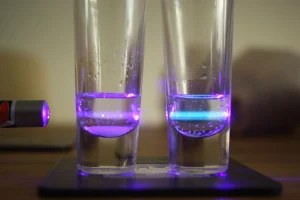
With the advancement of technology, the need for methane gas monitoring is increasing, especially in key areas such as natural gas extraction, storage, and transportation. Laser methane detection technology, with its unique advantages, is gradually becoming the preferred monitoring solution in these industries. This article will explore the principles, strengths, and applications of laser methane detection technology, and discuss why it outperforms traditional NDIR (Non-Dispersive Infrared) technology and other detection methods.

Size of Logoele Laser Methane Sensor: 80mm X 25mm X 25mm
How can laser used for detecting Methane?
Laser methane detection technology is based on Tunable Diode Laser Absorption Spectroscopy (TDLAS). This technology will be the future of methane detection and the price of lazer methane will be lower and lower. This technique uses a laser of a specific wavelength to pass through the gas being tested. Methane molecules absorb this specific wavelength of light, causing a reduction in light intensity. By analyzing the degree of light attenuation, the concentration of methane can be accurately determined.
Why laser is better than other technology?
The advantages of laser methane detection technology include:
- High Sensitivity: Capable of detecting methane concentrations at the ppm level, which is crucial for early detection of potential leaks.
- Fast Response Time: The response time is extremely fast, with the ability to complete detection in as little as 0.05 seconds, allowing for rapid response.
- High Selectivity: Unique selectivity for specific gases, not easily interfered by cross gases, reducing the possibility of false alarms.
- Strong Anti-Interference Capability: Not affected by environmental factors such as temperature and humidity, dust, smoke, etc., ensuring the accuracy of monitoring.
- Low Maintenance Requirements: Since it does not require direct contact with gases, it reduces the issues of sensor poisoning or aging, thereby lowering maintenance costs.
Application Scenarios
Laser methane detection technology is widely used in:
- Oil and Gas Industry: In the extraction, production, storage, and transportation of natural gas, it is used to detect and locate methane leaks.
- Chemical and Mining: In situations where methane accumulation may occur, such as inside mines, it is used for safety monitoring.
- Urban Safety and Environmental Monitoring: Monitoring the concentration of methane in the urban atmosphere to provide data support for environmental protection and urban safety.
Why It Outperforms NDIR Technology
Compared to traditional NDIR technology, laser methane detection technology shows its superiority in several aspects:
- Sensitivity and Selectivity: Laser technology offers higher sensitivity and selectivity, enabling accurate monitoring of methane in complex industrial environments.
- Anti-Interference Capability: Laser technology is not affected by environmental factors, while NDIR technology may be influenced by environmental conditions such as temperature and humidity.
- Maintenance Costs: Sensors in laser technology do not require frequent calibration, reducing long-term maintenance costs.
Comparison with Other Detection Technologies
In addition to NDIR, laser methane detection technology also outperforms other detection methods such as:
- Catalytic Sensors: These sensors can be sensitive to a range of gases and may not provide the same level of selectivity as laser technology. They also require regular maintenance to prevent sensor poisoning.
- Electrochemical Sensors: While they are good for detecting low concentrations of gases, they can suffer from long-term drift and require frequent calibration. They are also sensitive to humidity and temperature changes.
- Infrared (IR) Sensors: Although IR sensors can detect specific gases based on their absorption spectra, they may be affected by environmental factors and require regular maintenance.
Conclusion
Laser methane detection technology, with its high precision, rapid response, and robust anti-interference capabilities, holds great potential in the field of methane monitoring. As the technology matures and costs decrease, it is expected to dominate the methane monitoring market in the future, providing strong support for the safe use of natural gas and environmental protection.